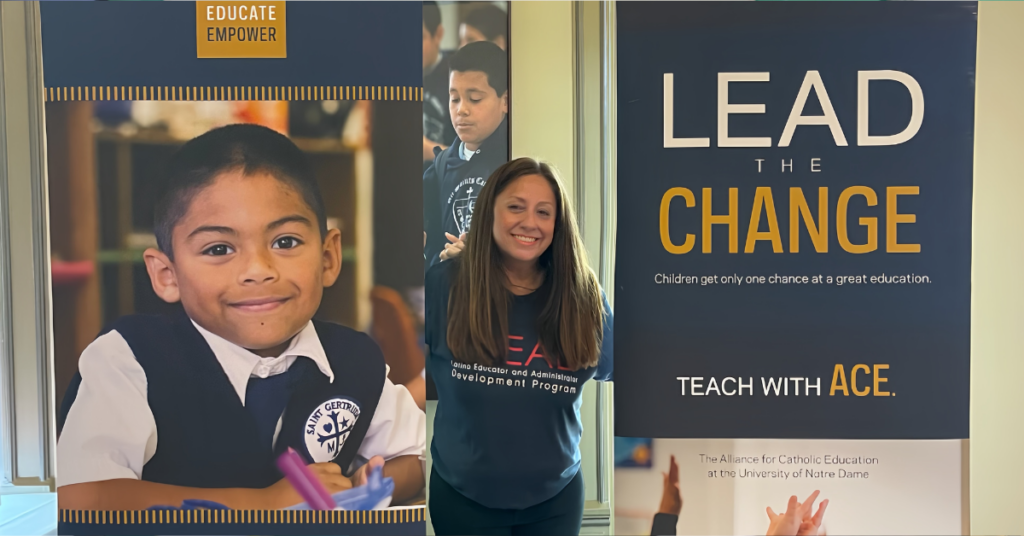
Written by Adriana Gutierrez, director of communications, St. Laurence Catholic School, Sugar Land, TX, adriana@myspanishlessons.com
Discovering leadership is often less about a single moment and more about a journey—one shaped by people, purpose, and faith. In the winter 2026 issue of Momentum magazine, we explored why leadership formation and representation matter so deeply in Catholic education. This reflection by Adriana Gutierrez, director of communications for St. Laurence Catholic School in Sugar Land, TX, brings together a personal leadership journey and a broader commitment to cultivating Latino leaders through the Latino Educator and Administrator Development Program (LEAD).
Answering the Call to Lead
When I was invited to participate in LEAD at the University of Notre Dame, I did not fully realize how much it would shape my professional journey. I simply knew I wanted to serve my school and my community more intentionally. I was searching for guidance, formation, and a clearer sense of purpose.
What I found through LEAD was not only professional growth, but also a deeper understanding of leadership as a vocation rooted in faith, culture, and service. The experience helped me see that leadership in Catholic education as a Latino educator is not confined to titles or seasons; it is cultivated over time through relationships, reflection, and intentional formation.
Leadership Rooted in Community
The program brought together leaders from across the country who met virtually every month. Despite geographic distances, those regular gatherings became a space for learning, honest dialogue, reflection, and connection. We shared challenges, celebrated successes, and learned from one another’s experiences. Over time, those conversations created a sense of belonging that sustained us throughout the program.
A Moment of Discernment at Notre Dame
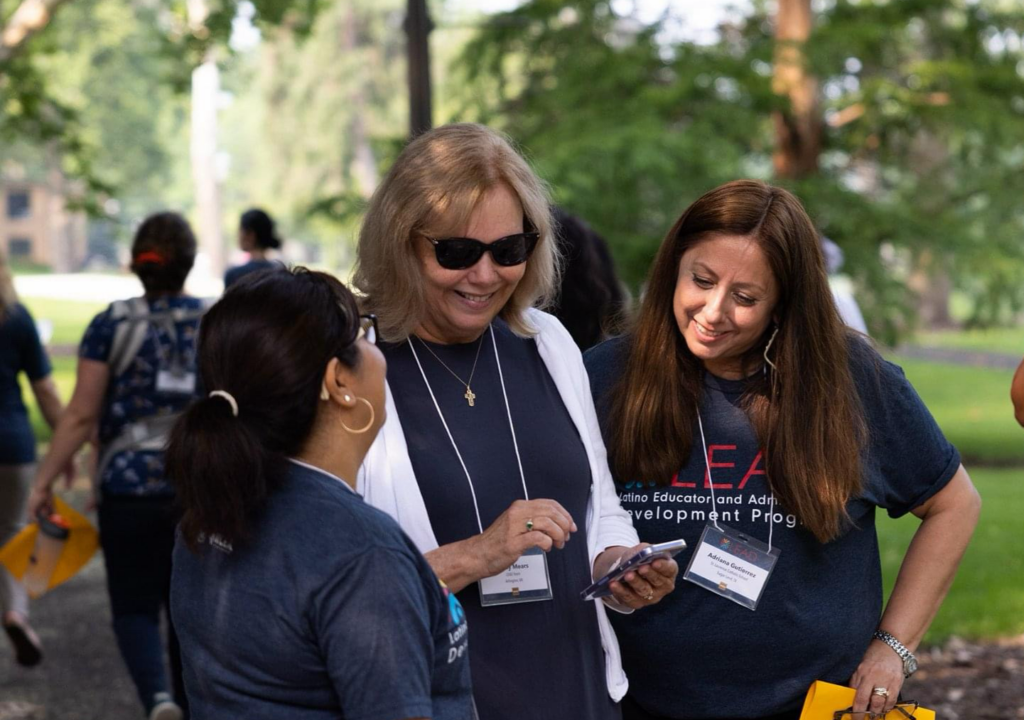
Our journey culminated at the University of Notre Dame, where we gathered for the closing program. Walking across campus and praying at the Grotto, I found myself reflecting on the students and families we serve and on the path that had brought me to that place.
In that moment, it became clear to me that LEAD was about far more than professional advancement. It was about discernment and how our gifts, identities, and faith are meant to serve the mission of Catholic education.
Representation as Mission
As a member of the first graduating class of LEAD in 2021, I feel both gratitude and responsibility. Being part of an inaugural cohort meant stepping into something new, trusting the process, and helping shape a program designed to respond to a real and growing need.
LEAD was created to address the underrepresentation of Latino leaders in Catholic schools and to strengthen leadership pipelines that reflect the communities we serve. It was not simply about education, enrollment strategies, or strategic planning but about people, culture, faith, and mission. Through the program, I came to understand that representation in Catholic education is not symbolic but rather relational, pastoral, and essential to belonging.
Leading with Faith, Culture, and Confidence
As a Latina working in Catholic education, I have always carried a deep love for my culture, my faith, and my community. LEAD affirmed that these are not just personal traits, but professional strengths that enrich our schools.
Bilingualism, cultural awareness, and authentic relationships with families are essential to building trust and sustaining the mission. When students and families see themselves reflected in the adults who lead and serve them, it communicates a powerful message: you belong here.
Leadership Beyond Titles
Through LEAD, I gained practical tools: how to communicate more effectively with families, how to build trust within diverse communities, and how to tell the story of Catholic schools in ways that resonate across cultures. More importantly, I gained confidence. I began to see myself not just as someone working in a school, but as a leader with a voice and a responsibility to advocate for others.
Since graduating in 2021, I have carried the lessons of LEAD into every aspect of my work. Whether through school communications, enrollment outreach, or community engagement, I strive to lead with authenticity and faith. LEAD taught me that leadership is not about titles—it is about service, listening, and creating spaces where everyone feels they belong.
A Growing Legacy of Leadership
Being part of the first graduating class will always be a special honor. It marked the beginning of a program that continues to shape leaders across dioceses nationwide. When I meet new LEAD participants or hear about the work of recent cohorts, I am reminded that leadership formation is an ongoing commitment, and I feel proud to be part of that legacy.
To any educator considering LEAD, my message is simple: Your story matters. Your culture matters. Your faith and experiences are not barriers to leadership—they are the very foundation of it.
For me, LEAD was not just a program. It was a turning point that helped me see leadership as a vocation rooted in faith, culture, and service. And for that, I will always be grateful.
