Written by Jennifer Dodds, director of spiritual development, Mount Notre Dame High School, Cincinnati, OH, jdodds@mndhs.org
At Mount Notre Dame High School (MND) in Cincinnati, OH, living the principles of Catholic social teaching is more than a curriculum goal, it’s a defining element of the school’s culture. Among the most vibrant expressions of this commitment is the student-led Earth Action Team, a group whose passion for ecological justice is reshaping habits, challenging assumptions, and inspiring a deeper love for our common home.
A Call to Ecological Conversion
Rooted in the Catholic social teaching principle of Care for Creation, these students respond daily to Pope Francis’ invitation to ecological conversion—an awakening to the truth that our relationship with the earth is inseparable from our relationship with God and one another. Their efforts intensified when MND began pursuing, and ultimately received, recognition as a “Laudato Si’ Community” through the Archdiocese of Cincinnati. Once students examined their school’s systems and habits through this new lens, their conviction became clear: When we know better, we have an obligation to do better.
Faith in Action
The Earth Action Team has quickly become a living model of faith in action. Senior leader Cecilia End, a committed member since freshman year, describes the group as a place where overwhelming environmental issues suddenly feel approachable.
“Earth Action Team gave me a place to start taking small steps,” she reflects. “Caring for the environment has deepened my faith; it’s hard to deny God’s presence when you’re watching a sunrise. God calls us to care for the earth just as God calls us to care for each other.”
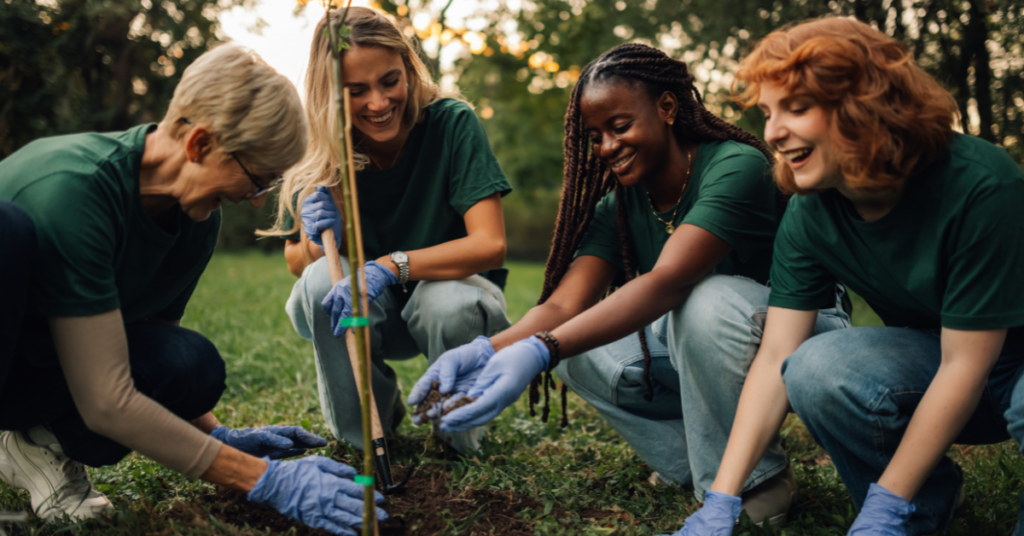
Earlier this school year, students launched a Pollinator Garden Team to care for a native garden established by the club in 2021. Through this work, students learn firsthand about biodiversity, the interconnectedness of ecosystems, and the delicate balance on which these systems rely.
Beyond their hands-on stewardship, the students have expanded their learning through guest speakers who helped them explore Fair Trade, sustainability, and global solidarity. These conversations sparked deeper questions: Who makes the products we buy? Were they treated justly? What responsibility do we carry as consumers?
One of the team’s most impactful projects this year was a “Swap, Shop, and Share” event created in partnership with the school’s St. Vincent de Paul (SVDP) Conference. Students were invited to bring gently used clothing, learn about the environmental and human costs of fast fashion, and “shop” from the communal collection.
Cecilia, who also serves as a leader of the SVDP Conference, played a major role in coordinating the collaboration. “Taking care of the environment protects the most vulnerable members of society,” she explains. “Climate change affects those without stable housing the most. It felt powerful to do something tangible that honored both the environment and our neighbors.”
The event was joyful and communal, offering students a new experience of sustainability rooted in solidarity. All remaining clothing was donated to a local St. Vincent de Paul thrift store, extending the impact far beyond campus.
Hope That Inspires the Future
Adult moderator Alicia Ausere sees firsthand how ecological learning naturally becomes theological awakening. “We have an opportunity to put our faith into action,” she shares. “Education and reflection assist our students in ecological conversion, a shift in how we interact with creation and understand who has access to its resources. When students become more conscientious about how their lifestyle impacts the earth and their neighbor, we see growth in solidarity, gratitude, and hope.”
The students’ efforts also draw profound inspiration from the Sisters of Notre Dame de Namur, who own and sponsor the school. Every student at MND learns about Sister Dorothy Stang, SNDdeN, who was a champion of the Amazon rainforest and its people, whose martyrdom for justice remains a powerful witness. Her life, along with the broader charism of the sisters, teaches that ecological justice is inseparable from human dignity.
Alicia notes that the sisters’ ongoing example profoundly influences the students’ worldview. “The sisters remind us that God is good and that we must stand with those made vulnerable by injustice. Our ecological efforts flow directly from that charism, everything is interconnected, and caring for creation is deeply tied to caring for the poor.”
Like many service-oriented initiatives in a busy high school environment, the Earth Action Team faces challenges. “The hardest part at MND is getting students to give up their free time,” Cecilia admits. “But once someone comes to one meeting, they usually come back. The passion I see in our members gives me so much hope.”
Alicia adds that the broader work of ecological conversion requires persistence. “High school students have so many things competing for their attention. Our task is to help them see that social and ecological justice deserve their attention too, so they don’t become hopeless or assume someone else will fix the problem.”
Yet despite the demands, hope continues to blossom. After hearing a sustainability analyst speak last year, several students told Cecilia how meaningful it was to learn that environmental careers are possible. Many applied to be team leaders this year, eager to deepen their commitment.
“It gave me hope,” Cecilia shares, “because it showed there are so many people who want to make a difference.”
The Earth Action Team continues to imagine bold possibilities. Soon they will visit the Cincinnati Recycling & Reuse Hub to learn about large-scale waste systems and responsible material management. They are also producing a schoolwide educational video about recycling guidelines, designing signage to reduce contamination, and researching solutions for more complex recycling needs—such as batteries, markers, and ink cartridges. Even when these solutions come with costs, the students remain undeterred.
As Cecilia wisely puts it, “It takes a lot of effort to make changes, but you have to start somewhere, one intentional step at a time.”
Their dreams moving forward include reducing the school’s carbon footprint, deepening educational efforts, expanding partnerships, and embedding integral ecology throughout MND.
Cecilia captures the spirit of the mission beautifully. “Caring for creation is an act of love—love for the earth, love for each other, and love for future generations. It’s never too late to start showing that kind of love.”
