
Written by Jodee Blanco, author, speaker, and founder of INJJA, jodee@jodeeblanco.com
Bullying isn’t just something that happens among students. As an anti-bullying expert and speaker who’s worked with hundreds of Catholic schools, I see another kind of bullying behavior that’s even more draining to educators—parents who bully the school.
Ironically, most Catholic school parents are reasonable and do their best to foster a healthy relationship with the school. It’s often just one small parent clique that creates such drama it can feel like a full-time job trying to manage the fallout. Here’s the truth. You can’t change how another person behaves, only how you respond to it.
Here are some of my tips for handling difficult parents with grace and turning conflict into growth.
It’s Not Personal
Fear is a primary emotion. Anger, hostility, rage, arrogance, blaming, denial, and other similar types of resistance are secondary emotions. When a person is afraid, especially a parent who’s nervous for their child, they may act out. If you can tell yourself that the parent who keeps testing your patience is driven by fear, that it isn’t personal, it will help you to have compassion for them, the first and most important step in breaking down barriers.
I’ve witnessed a mom tear into a principal at a PTA meeting over something innocuous because her husband left her that week. When you’re dealing with an unpleasant parent, there’s likely something in their lives making them vulnerable. If you approach them in a way that helps to restore their sense of control and not threaten it further, they’ll let their guard down and work with you.
Don’t Let a Parent Fester
If a parent is upset, the more they wait for their issue to be addressed, the more likely they are to fester. If you can’t attend to the situation right away, recognize their pain, apologize that you only have a few moments right now, express that they’re important to you, and arrange a meeting for as soon as possible. It doesn’t mean everything else has to stop, but it may mean you have to stop for a moment, no matter how inconvenient, because if the situation festers, it will be far more inconvenient when you do address it.
If you think it may be prudent to give the parent a cooling off period, ask yourself, “Am I holding off because I really do think it will help or because I don’t want to deal with the drama right now?” Be honest with yourself and work backwards from there.
Sometimes They Just Need to Feel Heard
When a parent is upset or escalating, sometimes all they want is to feel heard. It’s not agreement they need. It’s just knowing that you heard them and understand their perspective. Paraphrasing it back in your own words is often helpful.
Ascending Versus Descending Conversations
When someone tries to put you on the defensive, they want you to argue. They want to pull you down to where they are which is a frustrated, frightened place. Don’t give in. Don’t feed the negativity. Instead, pull them up to your level. Acknowledge that you hear them. Tell them you want to understand. Ask them to help you understand. Then listen. Keep listening. Resist the urge to become defensive. Ascend together.
Two-Step Active Listening Technique
- Step One: Listen with compassionate neutrality—make sure you don’t interrupt, get defensive or make the parent feel judged (be aware of your body language).
- Step Two: Paraphrase where they’re coming from in your own words and be earnest in your attempt to do this. Remember, it’s not necessarily agreement they’re looking for even though it may feel that way in the moment. It’s wanting to know that you understand and genuinely get it.
The Disarm and Defuse Technique
- Step One: If someone is venting, try not to interrupt. Remain quiet and listen. I realize that’s easier said than done, especially if you feel attacked. Breathe, inhale for four counts then exhale for four. Reach inside and find your empathy. Remind yourself that this person is likely acting out in fear. If they become verbally inappropriate or abusive, you can say something like, “Would you like to take a break?” or “Would you like to pick this up later?” By framing it as a question, it’s less likely to trigger defensiveness and gives them a sense of control.
- Step Two: After you’ve allowed the other person to feel heard, thank them for feeling comfortable enough with you to be that open and honest. There may be a pause as they take that in. Sometimes silence is the best punctuation mark. I love this technique because you can feel someone’s defenses dissipate.
Body Language
Be aware of body language. Sometimes it can make someone feel judged even though we’re trying our best to listen objectively.
Do your shoulders tense when someone puts you on the defensive? Do you cross your arms or start tapping your foot when your patience is being tested? Do your lips purse when you think you’re being lied to or misled? Before engaging in a potentially uncomfortable or tense conversation, take a deep breath, exhale slowly, and focus your awareness on your body, starting from the top of your head moving downward.
Lead with Truth and Compassion
Before any challenging or difficult conversation with a parent, ask yourself: What is my truth here? And be honest. Then, ask yourself: What is the most compassionate way to see that truth? Then, speak your truth. The key is to see your truth through the most compassionate lens possible, because if you see it with compassion, you’ll automatically communicate it that way. Also ask yourself: “Twenty years from now when I look back on this moment, how will I wish I would have handled it?” Navigate from there.
Compassion with discernment is a strength, not a weakness. When you access your humanity through empathy, your entire body language changes and the other person feels seen instead of threatened.
Turning A Problem Statement into a Challenge Statement
A problem statement is a statement of what’s wrong. A challenge statement is a statement of what we can do together to change the situation. For example, “Brianna is flunking math” versus “Let’s find a creative way to excite Brianna about the wonder and magic of math in her daily life—maybe there’s a Taylor Swift math club!”
The Essential Intangibles and Human Component
- Stillness is a super-power. If chaos is unfolding around you, take a beat. Breathe. Find a quiet moment to be alone and center yourself. And remember, fear makes people act out. The more you can remind yourself of that all too human truth, the more empathy you’ll harness which will help to ground you.
- Three Different Types of Silence:
- Non-productive: Giving someone the silent treatment
- Productive: Listening without judgement
- Dignified: Remaining silent to preserve your self-respect
- Be brutally honest with yourself because truth starts there.
- Emails, texts, and digital messages don’t have emotional context.
Compassion, empathy, genuineness are best communicated via spoken word. If it’s important and you want it to land correctly, call.
If you’d like more strategies and techniques, I hope you’ll join me in Minneapolis for NCEA 2026 Convention & Expo, where I’ll be giving a session on How to Handle Parents Who Bully the School. Please join me during Professional Learning Session 3 on Wednesday, April 8, at 10:30 AM in Room 200 CDE.
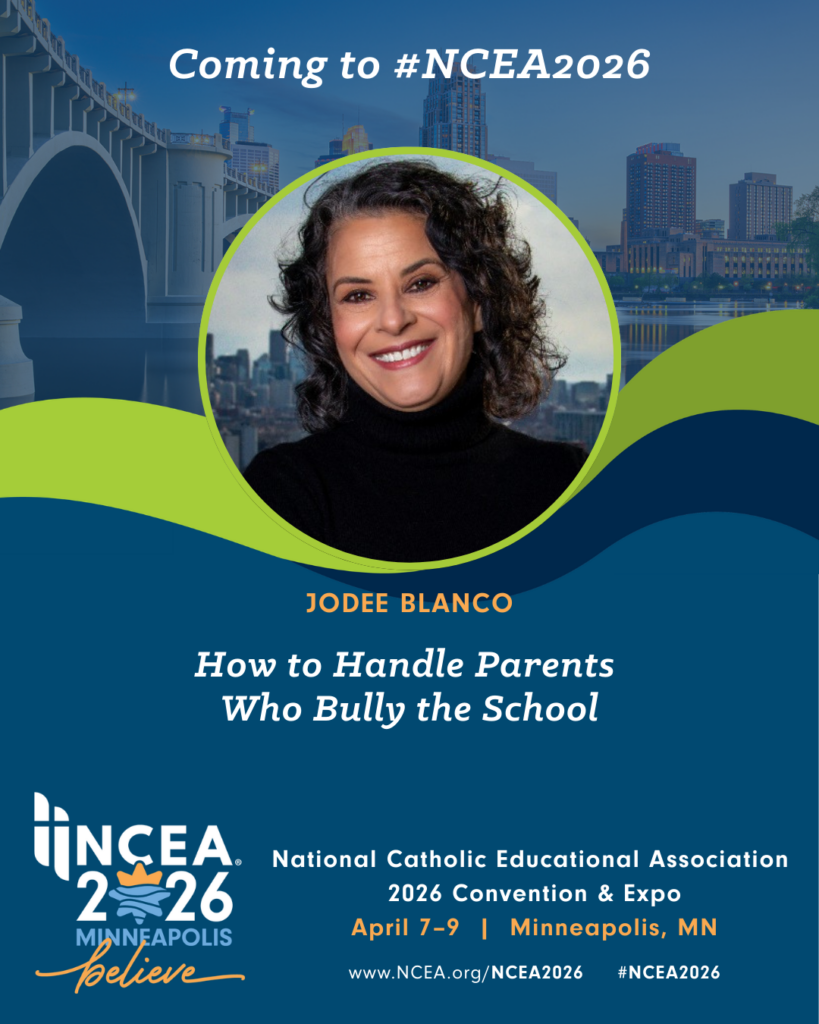
About Jodee Blanco
Jodee Blanco is the author of the seminal New York Times bestseller Please Stop Laughing at Me… and multiple other books including a series on bullying for NCEA. She is the founder of INJJA (It’s NOT Just Joking Around!), the first survivor-led anti-bullying program in the country. Jodee has keynoted educational conferences and done professional development for many dioceses and archdioceses and implemented INJJA in their schools. She has taught at the University of Chicago and New York University.
